LINK-DAT – Seamless integration and reuse of KDSF-compliant data for reporting and evaluation
LINK-DAT is a real-world laboratory in the field of plasma research which develops and tests technical innovations designed to simplify the collection and expand the use of KDSF-compliant research information under real-world conditions.
A particular added value for researchers and practitioners in the fields of research information, research evaluation and policy will be achieved through the semantic linking of existing current research information systems (CRIS) and research data management systems (RDMS) via a KDSF-based ontology. Through the use of hybrid AI systems that combine knowledge graphs with large language models in the field of machine learning (LLMs), this approach enables the automated collection and, in particular, the extended use of KDSF-compliant research information. Going beyond KDSF-based aggregate data, this makes it possible, amongst other things, to evaluate and quantify the significance of the methods, instruments and research infrastructures used for the recorded aggregate data.
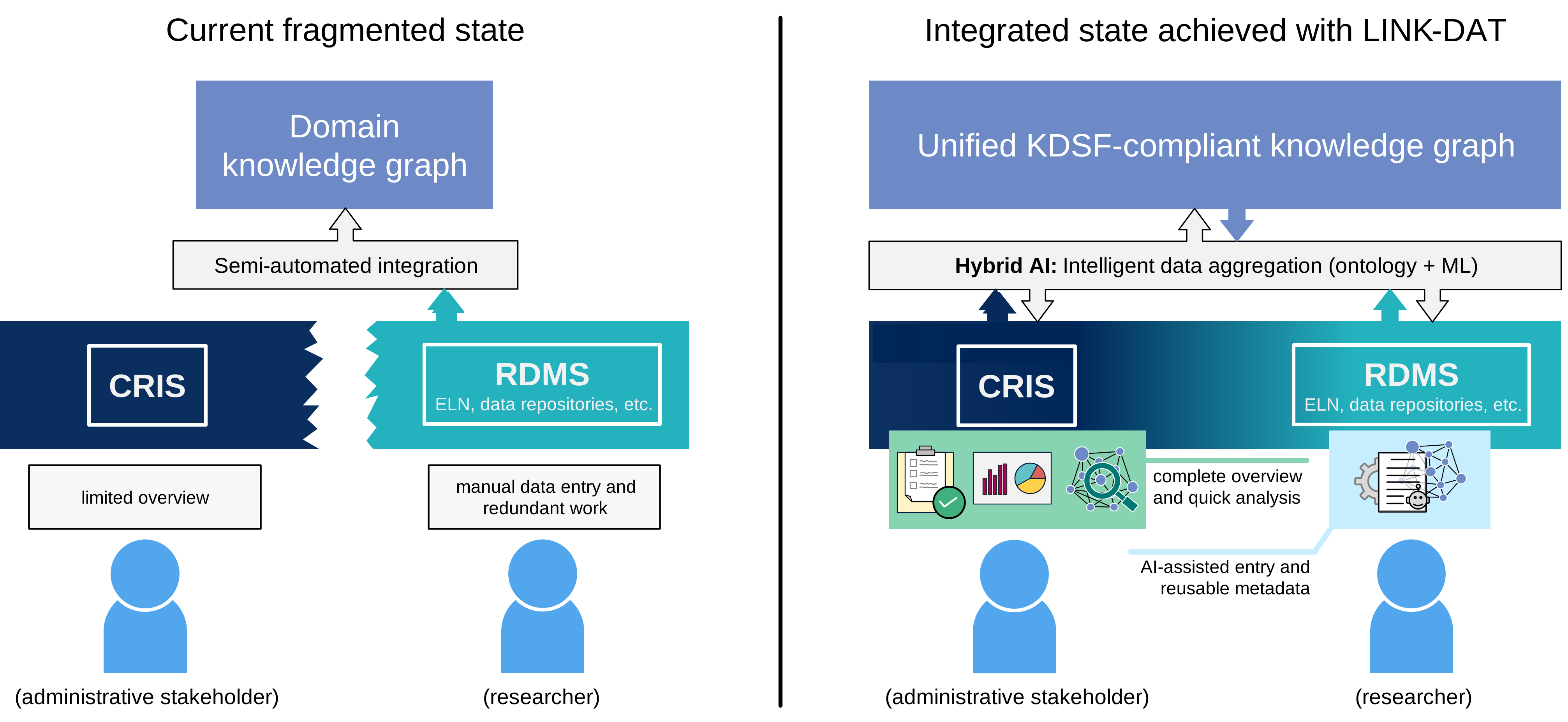
In addition to developing and field-testing these technical innovations based on existing data and knowledge management systems, LINK-DAT is investigating, within the framework of the real-world laboratory, the extent to which a uniform, KDSF-compliant knowledge base – achieved through the semantic aggregation of information from FIS and FDMS – improves institutional governance and the ability to answer strategic questions regarding impact and resource utilisation. At the same time, the project is examining the organizational and technical requirements necessary to achieve this. In this way, LINK-DAT provides practical recommendations for bringing the developed innovations into widespread use, including the expected benefits for the stakeholders involved at all levels.
Project information
Funding period
09/2026–08/2029
Project partners and contact
Leibniz Institute for Plasma Science and Technology (INP)
|
Dr. Markus Becker (coordination and project leader INP) E-mail: markus.becker@inp-greifswald.de Phone: +49 3834 554 3821 |

|
Christian Hauschke (project leader TIB) E-mail: christian.hauschke@tib.eu Phone: +49 511 762 14642 |
Funding
The project is funded by the German Federal Ministry of Research, Technology and Space (BMFTR) under the project numbers 16RBM4007A and 16RBM4007B.


